
Before you book
You will start in humid rainforest at around 25°C and stand on the summit at somewhere between −10°C and −20°C before windchill. Every packing decision follows from that spread.
At a glance
- Foothills
- Montane forest
- Heath and moorland
- Alpine desert
- Summit zone
- Weather variability
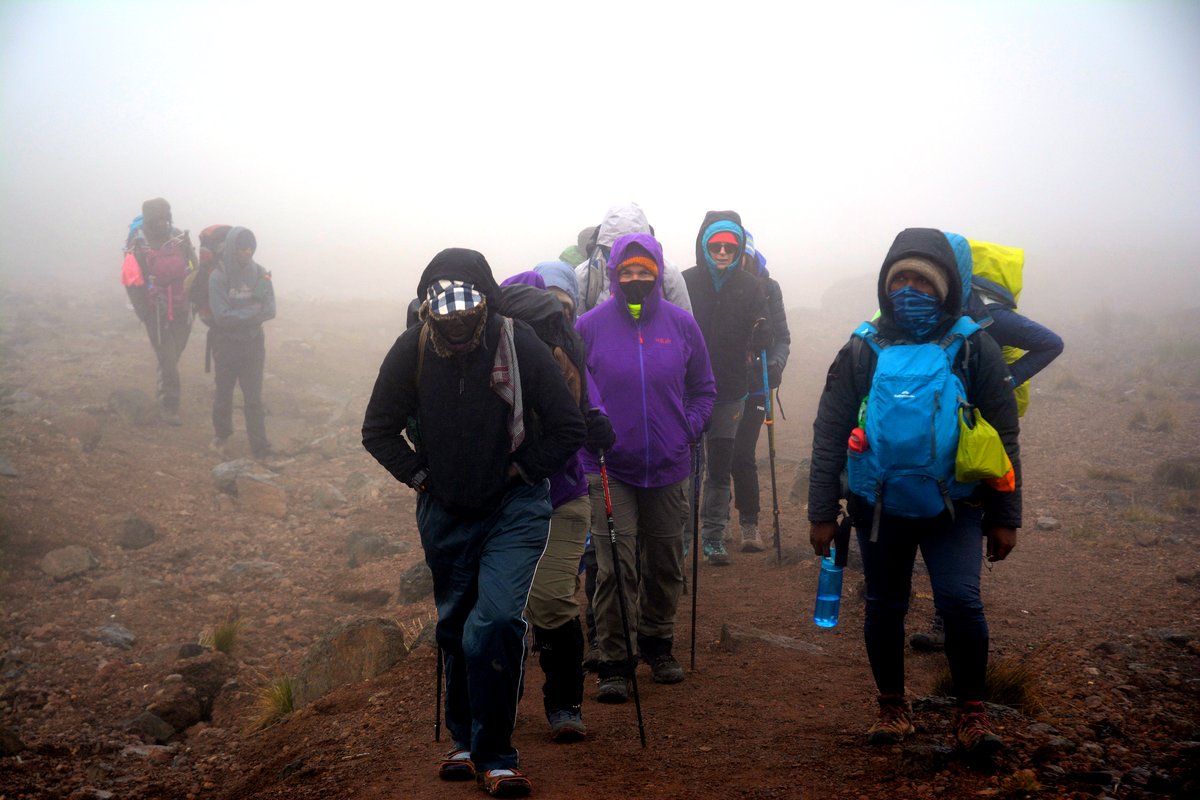
Kilimanjaro compresses dramatic climate changes into a few trekking days. Lower slopes are comparatively warm. The montane forest is humid and can be muddy, with rainfall possible even during otherwise dry periods. Higher heath and moorland become cooler, windier and more exposed. Above this, the alpine desert is dry, sparse and subject to strong solar radiation by day and cold after sunset. Near the summit, temperatures can be severely cold and wind chill can be significant. Snow, ice, cloud and rapid weather changes are possible. This is why a complete clothing system matters more than a single heavy jacket. You need the ability to add and remove layers while walking and to protect yourself from rain, wind, UV exposure and cold. Conditions—not the calendar alone—should drive daily clothing decisions.
You will experience roughly a fifty-degree Celsius temperature range in a single week, and almost all of it comes from altitude rather than season. That single fact drives every packing decision you will make.
Kilimanjaro creates its own weather. It is a 5,895 m obstacle standing alone on a plain, so air is forced up its flanks, cools, and dumps its moisture on the way. That is why the rainforest exists at all, and why the summit is dry, cold and bright while the forest below is soaking.
| Zone | Altitude | Daytime | Night | Conditions |
|---|---|---|---|---|
| Rainforest | 1,800–2,800 m | 20–27°C | 12–16°C | Humid. Rain likely in any month. |
| Moorland | 2,800–4,000 m | 12–18°C | 0–7°C | Bright days, cold clear nights, frequent mist. |
| Alpine desert | 4,000–5,000 m | 5–15°C | −5 to 0°C | Fierce sun, hard frost, very dry, high UV. |
| Arctic | 5,000–5,895 m | −5 to 5°C | −10 to −20°C | Sub-zero, wind, thin air. Before windchill. |
The pattern of a typical day
Above the forest, weather on Kilimanjaro is more predictable than most mountains. A common rhythm:
- Early morning — clear, cold, often the best views of the day
- Late morning — cloud builds from the valleys below
- Afternoon — cloud, mist, sometimes brief precipitation
- Evening — often clears again, and the temperature drops fast
This is why guides start early. It is not enthusiasm; it is that the mornings are reliably better than the afternoons.
Sun, not just cold
Three degrees from the equator and above most of the atmosphere, the ultraviolet intensity is severe. Sunburn is one of the most common complaints on the mountain and it happens on cold cloudy days as readily as bright ones. High-factor sunscreen, lip balm with sun protection and category 3 or 4 sunglasses are not optional items.
Wind
Rarely a problem in the forest or moorland. Above 4,500 m, and especially on the exposed ridge at Barafu and on the summit approach, wind is the thing that turns −12°C into something considerably worse. A windproof outer layer matters more than an extra fleece.
Snow
Fresh snow above 5,000 m is possible in any month and is more common after the rainy seasons. It rarely stops a climb but it makes summit night slower and colder, and it is one reason gaiters and proper gloves earn their place in the bag.
Does weather decide whether you summit?
Less often than people assume. Climbs are rarely abandoned for weather alone; the far more common reason for turning back is altitude. Bad weather makes an already hard night harder, and occasionally shifts a summit attempt by an hour or two, but it is seldom the deciding factor.
What weather does change is your experience of the week — whether the forest is a pleasant green tunnel or a mud bath, and whether you get the sunrise from Stella Point that everybody comes for.
Which month suits what you want?
Tell us when you can travel and what matters most — dry ground, empty trails, or price — and we will be straight about the trade-off.
More on before you book