
Before you arrive
You are training for consecutive long days on uneven ground, not for a race. The single most transferable session is a long hill walk carrying the pack you will actually use.
At a glance
- Aerobic base
- Hill and stair training
- Strength work
- Loaded hikes
- Back-to-back days
- Taper and recovery
Kilimanjaro preparation should emphasize hours on your feet rather than short bursts of maximum intensity. Train consistently with walking, hiking, stairs or hills, supported by strength work for legs, hips, core and upper body. Weeks 1–4 build routine and aerobic capacity. Weeks 5–8 increase hiking duration and introduce longer climbs with the daypack you expect to carry. Weeks 9–10 should include your longest back-to-back hiking days. Week 11 reduces volume while maintaining movement, and Week 12 is a taper focused on recovery, mobility, sleep and travel readiness. Training cannot guarantee acclimatization because altitude response varies between individuals. Anyone with medical concerns, significant chronic disease, recent injury or uncertainty about exercise at altitude should seek individualized medical advice before undertaking a training or climbing program.
There is a straightforward answer to how you should train for Kilimanjaro, and it is unglamorous: walk up hills for a long time, carrying the pack you will actually use, on consecutive days.
Almost everything else people do — gym programmes, altitude masks, interval work — is either marginal or irrelevant. What follows is what transfers, in rough order of how much difference it makes.
What you are actually training for
Not a race, and not one hard effort. You are training for:
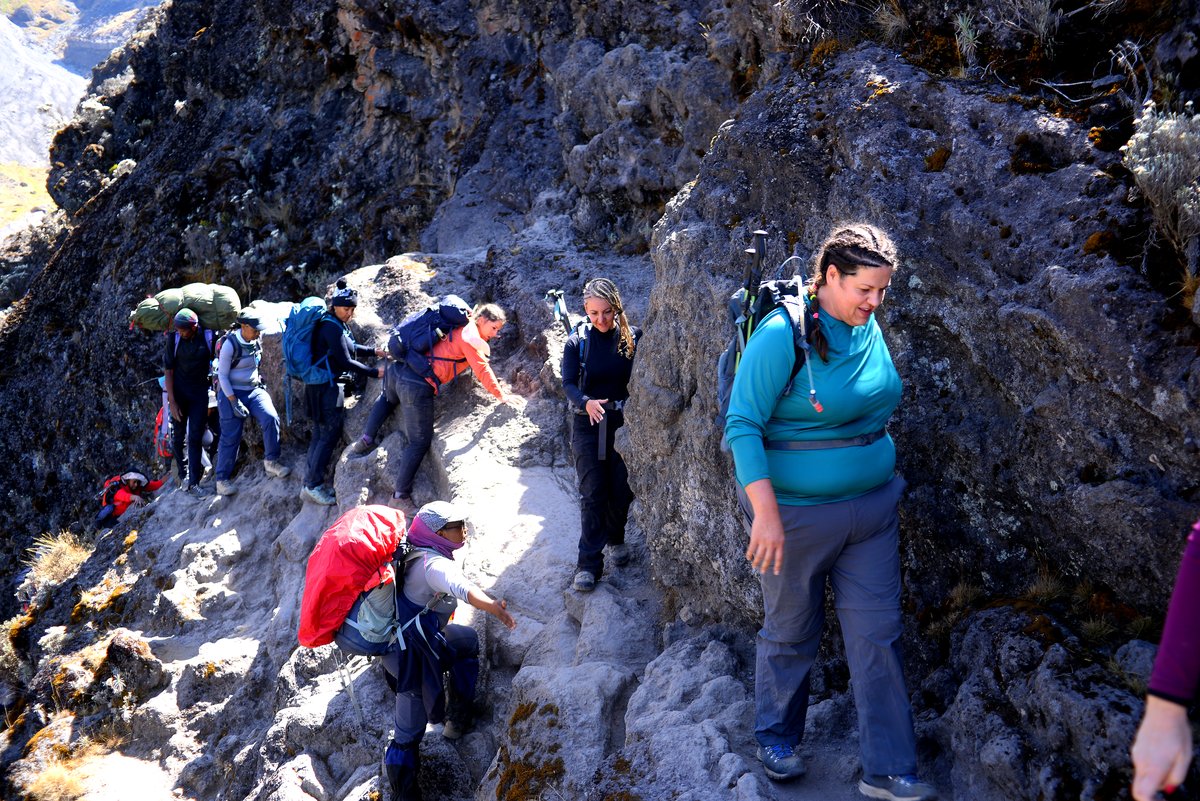
- Six to nine consecutive days of four to seven hours' walking
- On uneven ground, carrying a 5–8 kg daypack
- On poor sleep and reduced appetite
- Finishing with a twelve to fifteen hour summit day that starts at midnight
- Followed by a long, steep descent on tired legs
Endurance and durability matter enormously. Peak fitness matters far less than people assume — very fit climbers fail regularly, usually because they walked too fast in the first three days.
The session that transfers most
A four-to-six hour hill walk with 8 kg on your back. Then a shorter walk the next day, on tired legs.
That back-to-back weekend is the specific demand Kilimanjaro makes and the specific thing almost nobody trains. One long walk a week builds fitness. Two consecutive days builds the thing you actually need.
The thing nobody trains, and should
Walking downhill under load.
The Kilimanjaro descent is long, steep, and arrives at the end of the hardest day of your life. It is where knees give out and where people fall. More trips are spoiled on the way down than on the way up.
Downhill walking is eccentric loading and the only preparation for it is doing it. Add deliberate descending to every hill day. Use poles. Your knees on day seven will thank you.
| Weeks | Long walk | Other sessions | Focus |
|---|---|---|---|
| 1–4 | Build to 3 hours | 2 shorter walks or runs | Habit. Start carrying the pack immediately. |
| 5–8 | Build to 5 hours | 1–2 sessions, plus stairs or hills | Add a second walk the following day. Introduce deliberate descent. |
| 9–11 | 6 hours, full pack | One back-to-back weekend per fortnight | Peak. 6 hours Saturday, 3 hours Sunday. |
| 12 | 1–2 hours, easy | Rest | Taper. Arriving fresh beats arriving fit and tired. |
If you have no hills
Workable substitutes, in descending order of usefulness:
- Stairs. Repeated flights with a loaded pack. Tedious, effective, and the closest thing to summit night most flat places offer.
- Treadmill at maximum incline, walking not running, with the pack on. Do not hold the rails.
- Stairmaster, same principle.
- Long flat walks with a heavier pack. Builds endurance, does nothing for descent.
Strength work worth doing
Not much, but the useful parts are:
- Step-downs and single-leg work — directly protective for the descent
- Calf raises — the muscle that complains most on day seven
- Core — for pack carrying and pole use
Heavy lifting is not harmful but adds carried weight without adding relevant endurance.
Training as kit testing
Every session is also a rehearsal. Boots must have at least fifty kilometres in them before you fly. Socks, pack, poles and waterproofs should all be things you have already had a bad day in.
Nothing new on the mountain. It is a cliché because blisters on day two end more climbs than altitude does on day two.
The mental part, briefly
Summit night is largely psychological. The hours between 2am and 4am are cold, dark, monotonous and offer no visible progress. People who have practised being uncomfortable for a long time — a very long training walk in bad weather, deliberately — handle it better than people who have only trained in pleasant conditions.
How much training do you actually need?
Tell us your current walking background and we will be straight about whether twelve weeks is enough, or whether a longer itinerary would serve you better than more training.
More on before you arrive